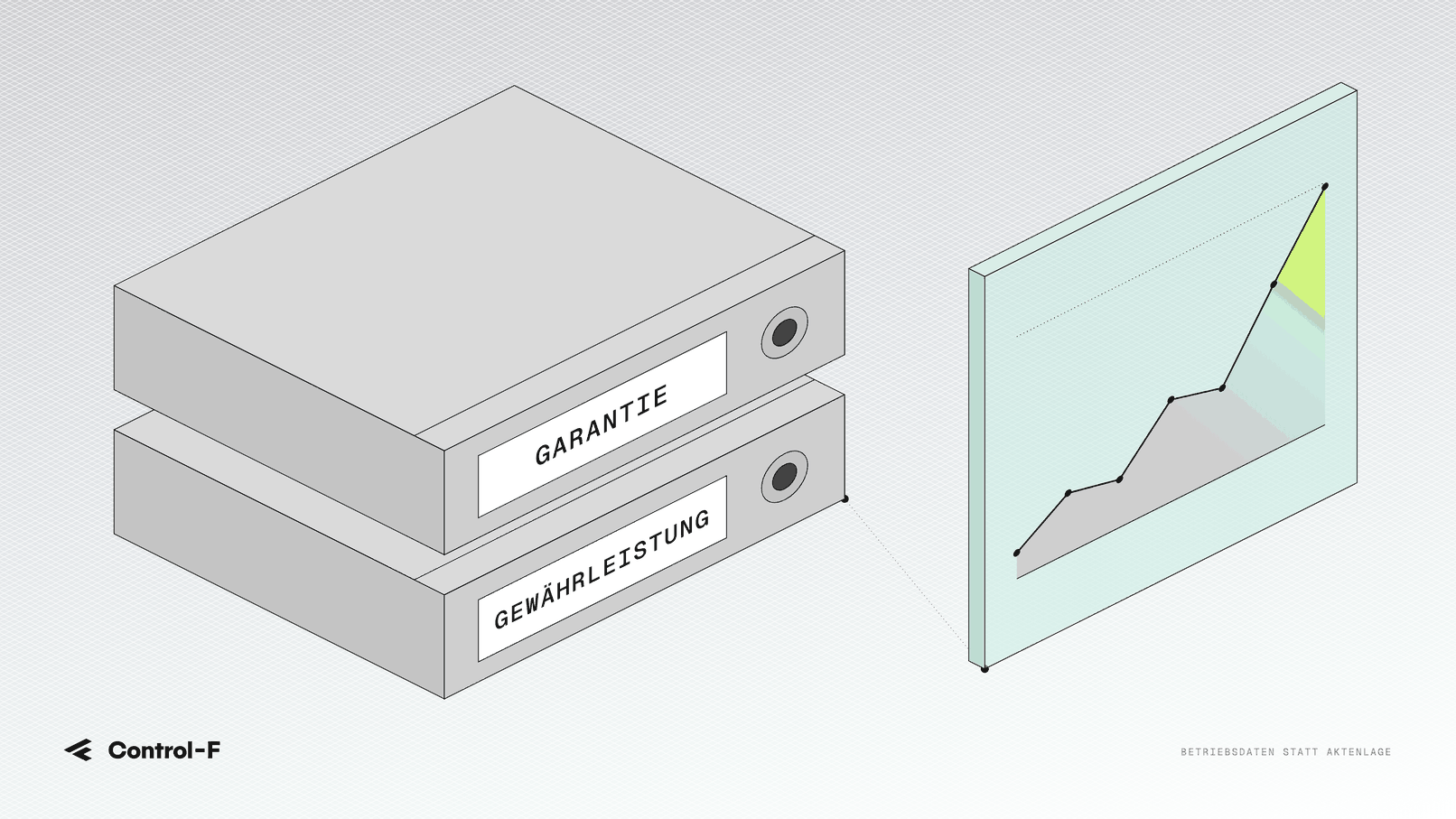
A wind turbine, battery storage system or gas turbine produces data during every hour of operation that shows exactly how the asset is performing. Yet much of this information never reaches the people who need it most: the operators themselves. On 20 November 2026, we will be exploring this topic in a joint webinar with the renowned law firm bbh.
Sensor, control, service and operational data often remains with the manufacturer, spread across several systems and stored in formats that are difficult to process further. Operators frequently see only a fraction of what their own asset already knows.
This is exactly where the Data Act comes in. Regulation (EU) 2023/2854 has applied since 12 September 2025 and requires manufacturers of connected products to give users access to the data generated by their own assets. Products newly placed on the market from September 2026 are also subject to an additional design obligation requiring data access to be considered from the outset. For operators of energy assets, this creates a new right of access that did not previously exist in this form.
Access is not the same as value
A right to data is only the first step. Better maintenance, less downtime and new opportunities for optimisation emerge only when that data is available, understandable and technically usable.
Operators gain little from receiving raw data in a format that nobody in their organisation can interpret. Between what the Data Act permits and what a business can actually do with the data lie a number of practical questions:
- Which interfaces and formats are accessible in the first place?
- Are the quality, context and history of the data sufficient?
- Can the data be integrated into existing processes and systems?
A webinar that brings both sides together
On Friday, 20 November 2026, control-f and the law firm bbh invite you to a joint online webinar from 10 to 11 a.m. CET that will address precisely this gap.
Thomas Schmeding, lawyer and partner at bbh specialising in energy and data protection law, will explain the legal perspective: which data can operators request from manufacturers? Which obligations and limits apply? And where do trade secrets or technical feasibility genuinely play a role?
Simon Deussen, managing director of control-f, will cover the practical perspective and show what commonly prevents operational data from being put to use – and how these obstacles can be overcome.
At the heart of the session is a joint predictive-maintenance case, complemented by a brief transfer to battery storage systems. Using a recurring fault or unplanned outage, we will examine which sensor, condition, fault and maintenance data is required, the legal basis on which it can be requested, and how this can ultimately become a robust business case.
We will remain honest about the figures. Where reliable numbers have been approved for use, we will use them. Otherwise, we will work transparently with assumptions and a traceable example calculation – without making sweeping savings promises.
Who will benefit from this session?
The webinar is aimed at decision-makers in the energy sector as well as in plant and mechanical engineering, particularly those who use or operate energy assets themselves – from offshore electrolysis and wind farms to battery storage systems and gas turbines.
Anyone who has struggled to obtain manufacturer data or is wondering what the Data Act means for their own assets will gain both perspectives in a single session: the legal and the technical.
The agenda at a glance
After a brief introduction to the situation, bbh will provide the legal classification: which data can you request under the Data Act, and where are the limits? control-f will then explain the practical obstacles between a legal entitlement and actual usability. This will be followed by the joint business-case example before bbh returns to the use and sharing of data and the relevant legal limits. The session will conclude with time for your questions and a concrete next step.
Register now
Ideally, bring a specific asset and a specific use case from your operations. Anyone interested can follow up with an individual deep dive with control-f and bbh, bringing together the data entitlement, technical feasibility and economic potential for their own asset.
Kategorie / Category: Blogposts
Book the webinar now
Register for the joint webinar hosted by control-f and bbh. We will email you the invitation link.