An asset fails a few months before its warranty expires. The operator sees a product defect; the manufacturer suspects operation outside the specifications or missed maintenance. Both have understandable reasons for their position, but rarely solid evidence to support it. What follows is lengthy correspondence, expert reports, goodwill negotiations and, in the worst case, litigation that takes longer than the repair itself.
High litigation costs and lengthy downtime
There is no need to invent a hypothetical case: court costs and lawyers’ fees can be calculated precisely from the statutory fee schedules. For a claim valued at €100,000, court costs under the current schedule amount to €3,594 at first instance, €4,792 at second instance and €5,990 at third instance. For a claim valued at €200,000, legal fees for your own side add around €12,000 to €14,000 net, with roughly the same amount again for the opposing side. Technical disputes also involve expert reports. Third parties are engaged at a cost running into five figures to find information that, in fact, already exists.
Every modern asset generates precisely the information missing in a dispute during every hour of operation. Temperatures, load profiles, switching cycles, fault messages and maintenance activities are recorded, just not in one place. Control data sits with the manufacturer, maintenance records with the service partner and operational data with the operator in an entirely different system.
The problem starts long before the failure
When a dispute arises, each side reconstructs a story from its own fragment of the picture. Who ultimately prevails then depends less on the facts than on who can sustain the legal battle longest. So let me offer an example to make this tangible.
An example from battery storage
A commercial business operates a battery storage system with a ten-year warranty. Its terms depend on a maximum energy throughput, an allowable temperature range and compliance with maintenance intervals. After four years, the operator reports capacity degradation that, in their view, has taken the system below its guaranteed remaining capacity, and requests replacement modules.
If data from the battery management system, inverter, energy management system, environmental sensors and service records has been brought together in a shared database from the outset, timestamped and stored in a tamper-proof manner, the case looks different. Warranty conditions can then be translated into verifiable rules, such as cumulative throughput, hours outside the temperature range or overdue maintenance. Instead of competing expert reports, both sides quickly have access to a shared reconstruction of events.
If it shows operation within the specifications and unusual degradation of individual modules, the claim is justified and the manufacturer can settle promptly instead of spending months investigating. If, on the other hand, it shows that the storage system operated for long periods in an uncooled room above the permitted temperature range, the scope of the claim can be assessed objectively, using evidence the operator can understand and verify. In either case, agreement becomes considerably more likely than litigation.
The greater opportunity, however, lies before the damage occurs. If the system detects that a storage unit is consistently running too hot or approaching a warranty limit, the operator can be warned while there is still time to address the issue. This can also involve notifying the OEM, which must itself have an interest in preventing the damage. For the manufacturer, a warranty claim prevented is cheaper than any dispute won.
The Data Act provides the framework
The Data Act has applied since 12 September 2025. It gives users of connected products a right to access the data generated by their assets, and for products newly placed on the market from September 2026, that access must be built into the design. Less widely discussed, but crucial for warranties, is the other side of the equation: manufacturers may use non-personal data from the product only on the basis of a contract with the user.
For data-driven warranties, this means that the use of data must be openly agreed. Quietly analysing it when a dispute arises is no longer a viable model. This is precisely where an opportunity lies for both sides. Transparently agreeing how data will be used in the warranty context creates a basis that manufacturers and operators can both inspect.
The operator can check what the manufacturer sees, and the manufacturer can rely on data whose use has been agreed. That is the difference between data as leverage and data as a shared factual basis. For manufacturers currently bringing new products to market, now is the right time to incorporate this into their warranty terms.
Access alone is not enough
A right to data is only the first step. Raw data in formats that nobody in your organisation can interpret, without context or a complete history, is of little help in a warranty case. Only when control, service and operational data is brought together, checked for plausibility and stored in a way that remains traceable over time does it become documentation that both sides can rely on. That is what we work on at Control-F.
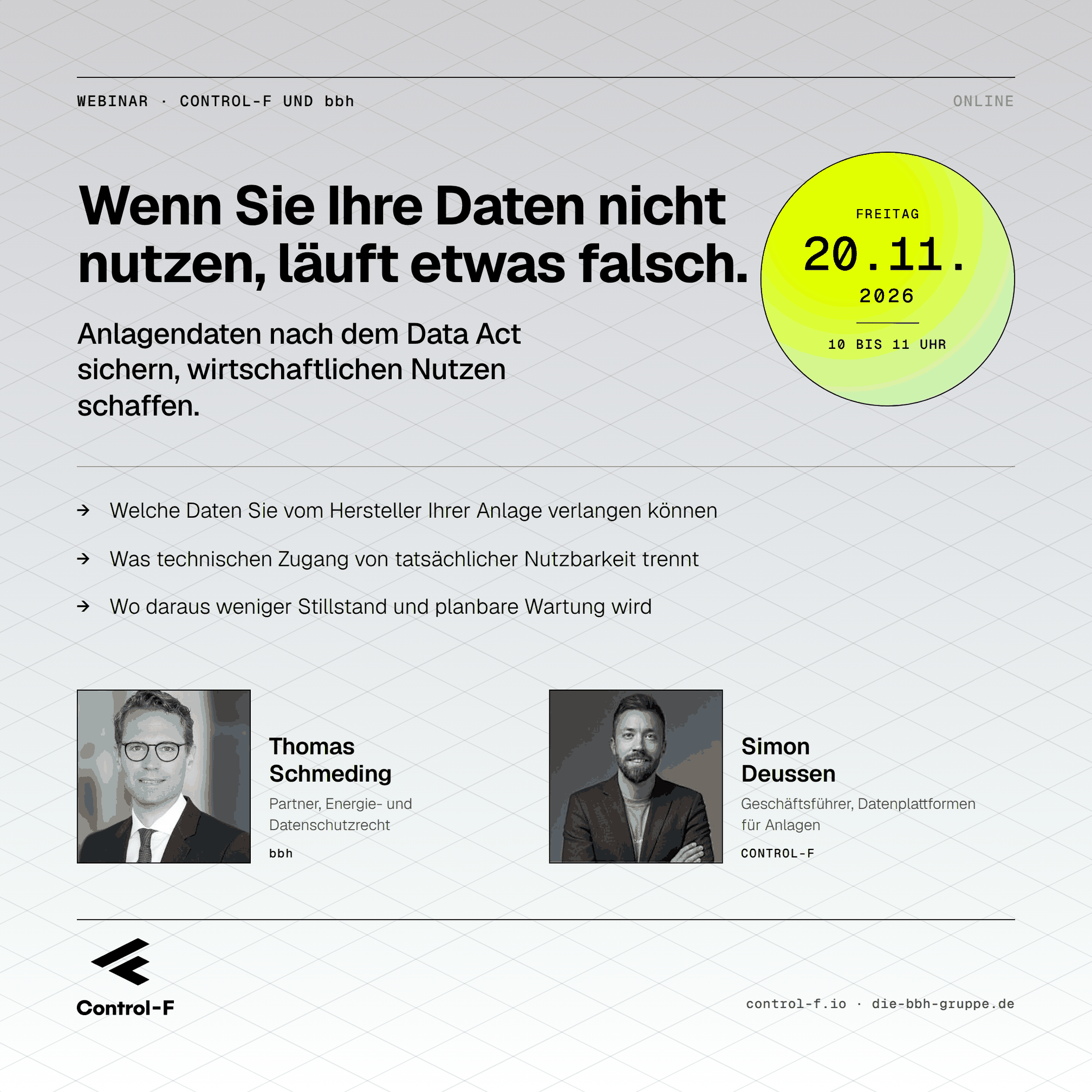
On 20 November 2026, we will discuss this together with the law firm bbh in a webinar from 10 to 11 a.m. CET. Thomas Schmeding will explain the legal side of the Data Act, while I will show what most commonly prevents asset data from being put to use in practice. The webinar is free to attend, and you can register here: Register for the webinar.
Kategorie / Category: Blogposts